Permanent Outdoor House Lights: What They Really Cost
Wondering what permanent outdoor house lights really cost? We break down real price ranges, system options, and budget-friendly ways to get year-round LED lighting.
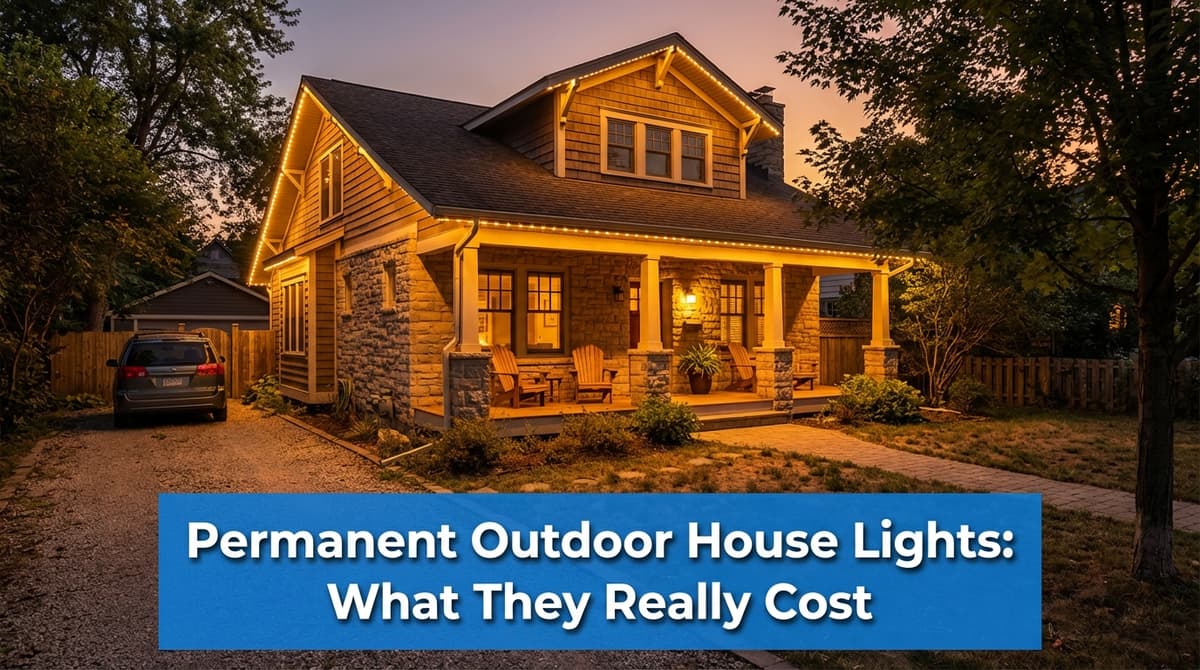
How Much Do Permanent Outdoor House Lights Really Cost?
We recently got a call from a homeowner — let’s call her Kelly — who lives in a cozy 1950s one-level home. She told us, “I don’t even know if this should be a priority with everything else getting more expensive, but I really love lights. They’d just make me happy.”
What she wanted were year-round LED lights along the outline of her roofline — what she called “framing the outside,” and what we’d usually mount along the soffit and fascia. She’d heard everything from $1,000 to $5,000 from friends and neighbors and wanted to know what was realistic.
That conversation with Kelly is exactly the kind of call we get all the time, so we figured we’d turn our answers into a simple guide you can use when planning your own permanent outdoor lighting.
The Real Price Range: From Simple Installs to Estate-Level Projects
When Kelly asked for a ballpark, we gave her the same honest range we’ll give you: permanent outdoor house lights usually run anywhere from about $1,000 on the very low end up to $10,000+ for a typical home.
That’s a big range, so here’s how it usually breaks down for most homeowners:
- Smaller one-story home, front-only roofline: roughly $1,000–$3,000
- Average single-family home, front + sides or key accents: about $3,000–$7,000
- Larger homes or full-perimeter installs: often $7,000–$10,000+
And then there are the outliers. On the day we spoke with Kelly, we were installing a high-end, fully customized system on a very large property that came in around $36,000. That’s obviously not typical, but it shows how much home size, complexity, and options change the price.
What Actually Drives the Cost of Permanent Lights?
Kelly’s home was a one-level 1950s house, which raised a great question: “We don’t even have exterior outlets that I know of — does that make it way more expensive?”
The answer is that several factors stack together to create your final price:
- Linear footage of lights – The more roofline or soffit you want to trace, the more lights, wiring, and labor are required.
- Height and access – One-story homes are usually easier (and less expensive) than tall, steep, or awkward rooflines that need extra safety gear and time.
- Power and controls – If you already have accessible outdoor outlets in the right areas, that keeps costs down. Older homes without convenient power may need new outlets or a cleaner power run.
- System quality & brand – There’s a big difference between entry-level, “fun for a few years” systems and professional-grade systems designed to last decades.
- Design complexity – Simple white outlining is cheaper than a fully programmable, multi-zone color system with animations and app-based control. </n
So while we can talk in ranges, the real price comes from matching your house, your goals, and your budget to the right setup.
Govee vs. Minleon: Short-Term Fun or Long-Term Investment?
On the call, we walked Kelly through the two main system types we install most often: Govee and Minleon. They both offer color-changing, app-controlled fun, but they serve different needs and budgets.
Govee: Budget-Friendly, Great Effects, Shorter Lifespan
These are what we’d call the entry-level permanent lights:
- Pros: Lower upfront cost, wide variety of colors and effects, app control, great for seasonal decorating.
- Cons: Not designed as a decades-long system, components typically last only a few years in real-world conditions.
Govee makes sense if you want to keep costs down now and you’re OK with potentially upgrading or replacing the system down the road.
Minleon: Professional-Grade, Designed to Last
Minleon is the system we suggest to homeowners like Kelly who tell us, “We want something that will last more than a couple of years.” This is what we described to Kelly:
- Rated lifespan: Engineered to last up to 45 years at 8 hours per day under laboratory testing conditions.
- Build quality: Heavier-duty components, weather-resistant, made for permanent architectural installs.
- Experience: Smooth dimming, rich colors, and a polished, built-in look along the soffit or fascia.
Minleon typically costs more upfront, but for many homeowners it’s a “do it once, do it right” investment instead of a repeating expense every few years.
What If Your Home Is Older or Lacks Exterior Outlets?
Kelly’s 1950s home on the South Hill is similar to a lot of older houses we see: charming, but not always wired for modern outdoor lighting.
If you don’t have obvious exterior outlets, that doesn’t automatically disqualify you from permanent lighting, but it does change the discussion. Here’s how we usually handle it:
- We inspect existing power options – Sometimes there are usable outlets or circuits tucked away that homeowners forget about.
- We plan discreet power runs – When needed, we can often add power in a way that stays hidden and protected.
- We’re honest about feasibility – Some homes, due to layout or safety concerns, just aren’t a good fit. In those cases, we’d rather say no than sell you something that won’t perform well.
If you live in an older home and you’re unsure about power, a quick site visit or detailed photos usually give us enough information to tell you what’s realistic before you commit.
Can You Install Permanent Lights in Phases?
One of Kelly’s biggest concerns was budget: “What if we can’t afford the whole house at once?” That’s something we hear frequently, especially with today’s prices on everything else.
The good news is, you don’t have to do it all in one shot. We often help homeowners break the project into manageable phases:
- Phase 1: Front roofline or the main section facing the street.
- Phase 2: Add the sides or key architectural features like peaks and gables.
- Phase 3: Finish the full perimeter or add backyard/patio lighting.
We’ve had many customers do $1,000–$2,000 of work each year until their home is fully outlined. When planned correctly, each phase ties into the last so the system feels seamless, not pieced together.
Planning Your Budget for Year-Round LED House Lights
If you’re like Kelly — you love lights, but you’re trying to be realistic with your budget — here’s a simple way to plan:
- Decide your timeframe: Is this a “treat yourself now” project, or something you’d rather spread over 2–3 years?
- Prioritize areas: Most people start with the front elevation where the lights have the biggest curb-appeal impact.
- Choose your system type: Short-term savings (Govee) vs. long-term investment (Minleon).
- Get a detailed quote: A good quote should break out materials, labor, and options so you can clearly see where your money’s going.
Permanent outdoor lighting isn’t just for the holidays anymore — it’s for everyday ambiance, security, and year-round celebrations. Whether your budget is closer to $1,000 or $10,000, there’s usually a way to scale the project to fit your home and goals.
If you’re curious what your specific house might cost to light, the next step is simple: let us take a look, talk through your priorities, and put real numbers to your ideas — just like we did with Kelly.